

| ISID organised a research seminar on India’s High-Tech Leap, Industrial Policy and Future of Innovation on April 24, 2026. Prof Sunil Mani, Honorary Visiting Professor, Centre for Development Studies (CDS) Trivandrum, and Professorial Fellow, IEDL, University of Athens made a presentation based on his forthcoming book on the subject. The session was chaired by Prof Aditya Bhattacharjea, Visiting Professor, ISID. Distinguished panellists included Dr Sujit Bhattacharya, Adjunct Professor, Amrita University, and former Chief Scientist, CSIR-NIScPR; Dr Saradindu Bhaduri, Associate Professor, Centre for Studies in Science Policy, Jawaharlal Nehru University (JNU); and Dr Sabyasachi Saha, Associate Professor, Research and Information System for Developing Countries (RIS). The presentation explored how strategic government support can drive innovation and competitiveness, especially in emerging economies. Prof Mani highlighted India’s industrial successes, such as global IT software services, pharmaceutical industries and sustainable technologies, as well as the drawbacks of their reliance on imports and weak coordination. The interesting discussion highlighted the need for reducing import dependence. Currently import dependence is extremely high for high-tech products. A major hurdle in reducing import dependence is that, various components are covered by patents, which is leading to the need for licensing. Further, the technology-trade balance of trade in India is increasing rapidly. Out of this, the receipts are not generated much from hard core technologies. |
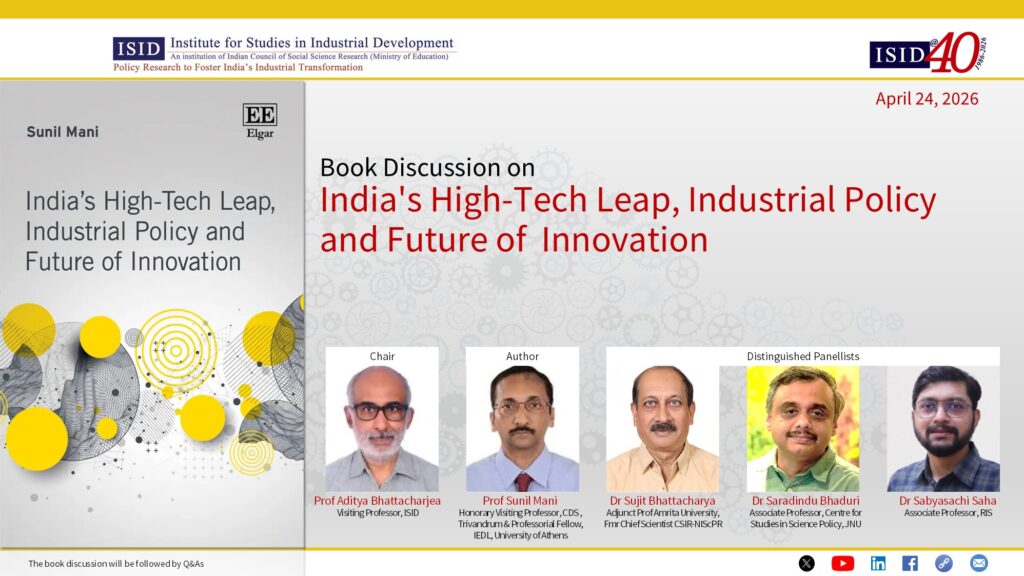 |
| About the Book: This incisive book explores how strategic government support can drive innovation and competitiveness, especially in emerging economies. Sunil Mani highlights India’s industrial successes, such as global IT software services, pharmaceutical industries and sustainable technologies, as well as the drawbacks of their reliance on imports and weak coordination.
Mani investigates how India has used government policies to boost high-tech industries, and assesses a variety of strategies including funding research, tax breaks and promoting local manufacturing. He incorporates in-depth sectoral case studies to present a detailed analysis of high-tech industries and their economic impact. Chapters showcase industry-specific insights and a global comparative approach to reveal lessons on effective state intervention. The book proposes an actionable policy roadmap with concrete steps for India’s high-tech future, from strengthening supply chains and boosting skill advancement to fostering public-private research and development partnerships. India’s High-Tech Leap, Industrial Policy and Future of Innovation is an enlightening read for scholars and students of industrial policy, innovation studies and economic development, as well as science and technology studies. It is also a beneficial resource for policymakers and practitioners in pharmaceuticals, IT services and renewables for its practical recommendations. |
| About the Author: Sunil Mani, Visiting Professor, Centre for Development Studies, Trivandrum, Kerala and Ahmedabad University, Gujarat, India |
|
Date: Friday, 24th April 2026 from 3.30 PM onwards |