

 |
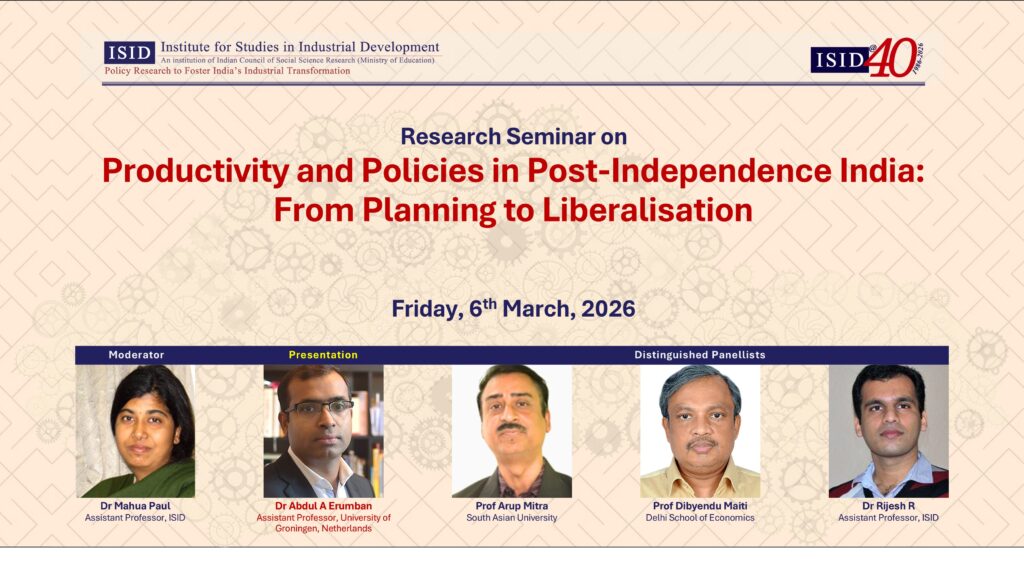
| ISID organised a Research Seminar on Productivity and Policies in Post-Independence India: From Planning to Liberalisation on March 6, 2026. Dr Abdul A Erumban, Assistant Professor, University of Groningen, The Netherlands, presented his study on India’s productivity and policy evolution (1950–2024), from import-substitution and licence raj to post-1990s liberalisation and service-led growth, assessing implications for labour productivity, total factor productivity, and structural transformation. The study highlighted persistent constraints, including limited industrialisation, informality, and human capital gaps, resulting in uneven productivity gains, particularly in manufacturing. The discussion emphasised coordinated policy action, greater investment in technology, R&D, and skills, and underscored emerging challenges such as artificial intelligence and climate risks. The seminar was moderated by Dr Mahua Paul, Assistant Professor, ISID, with distinguished panellists including Prof Arup Mitra, South Asian University; Prof Dibyendu Maiti, Delhi School of Economics; and Dr R Rijesh, Assistant Professor, ISID. The seminar concluded with an engaging discussion and Q&A session with participants. |
| Abstract: This paper provides a historical overview of productivity trends and pro- (and anti-) productivity policies in post -independence India. It examines the various phases of India’s economic policies, from the early adoption of socialism and the restrictive “licence raj” system, through the pro-business reforms of the 1980s and the pro-market liberalisation of the 1990s, to more recent initiatives in infrastructure development, and digital inclusion. The paper traces the evolution of labour productivity, total factor productivity, and structural changes during these policy phases. It highlights the productivity challenges in the early phases, with a gradual improvement following the liberalisation in the 1990s. While the structural change, featuring a shift away from agriculture to services, was generally growth-enhancing in the post -reform periods, the paper notes an uneven pattern of productivity growth. Limited industrialisation, the persistence of a large informal sector, and continuing human capital constraints remain key challenges for productivity -enhancing policies. The paper suggests the need for coordinated sectoral and macro-level reforms to achieve broader productivity gains, leveraging the potential of both the services and manufacturing sectors in future policies. It also acknowledges the role of disruptive yet transformative artificial intelligence and rising climate risks in shaping India’s productivity path, requiring proactive investment in human capital, technological readiness, and climate -resilient development. |
|
Date: Friday, 6th March 2026 from 3.30 PM onwards |